What a consolidation warehouse actually does
Finished goods from each factory are delivered to a central warehouse, checked against their packing lists, and held until every line item in the order is ready. Only once everything has arrived does the full order get palletised and loaded into a single container.
Why this saves money, not just hassle
Three separate LCL shipments each carry their own minimum freight charge, documentation fee and destination handling cost. Combining them into one FCL container spreads those fixed costs across the whole order instead of paying them three times over.
The trade-off: your shipment waits for the slowest factory
Consolidation means your container doesn't leave until every factory has finished production — a delay from one supplier holds up the whole shipment. Building a buffer into each factory's production deadline is the usual way to manage this.
What to check before choosing a consolidation partner
Ask how incoming goods are quality-checked on arrival at the warehouse, how long items can be held before storage fees apply, and how loading plans account for damage-prone items like upholstery and glass.
How the loading plan prevents damage
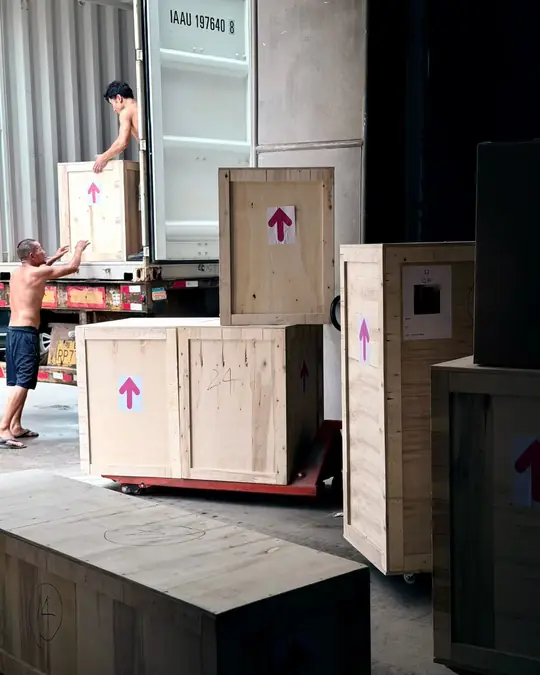
A container is packed to a plan, not simply filled. Heavy casegoods go low and toward the centre, upholstery is protected from compression and contact with hard edges, glass and stone travel on edge and braced, and nothing heavy is stacked on anything that can deform. The plan is usually drawn before loading and checked against the actual stack.
This is the step buyers most often leave entirely to the warehouse, and it is the one most directly connected to how the goods arrive. Furnitures crushes itself under its own weight across a two-week sea passage, and a damaged delivery is rarely recoverable from the carrier in full.
Documentation when goods come from several factories
A consolidated shipment from three factories is not three shipments on paper. Customs generally sees one consignment against one bill of lading, with a single exporter of record and a commercial invoice that has to reconcile with the packing list and with what is physically in the container.
Where several factories contribute, that means the line items have to be built from several sets of documents and stated with HS codes per line. Getting this consistent before the container is sealed is what prevents a customs query that costs far more in delay than the documentation took to assemble.
When not to consolidate
Consolidation is not automatically right. If one factory is badly late, holding two complete orders hostage to it can cost more than the freight saving — particularly where one of the lines is needed for a fixed date. Shipping the ready portion and consolidating the rest is often the better call.
The same logic applies to high-value or highly fragile items, and to orders crossing a time-sensitive season. The useful test is whether the freight saved exceeds the cost of the delay you are accepting, and that calculation depends on your deadlines rather than on the freight rate alone.
Free tool: work out what your order actually lands at per unit with the furniture landed cost calculator — FOB through to delivered.
Common questions
What does a consolidation warehouse do?
Finished goods from each factory are delivered to one warehouse, checked against their packing lists, and held until everything has arrived — then loaded together as a single shipment against one set of export documents.
How does consolidation save money?
Three separate LCL shipments each carry their own minimum freight charge, documentation fee and destination handling cost. Consolidating turns those into one shipment with one set of fixed costs — usually the largest single saving on a multi-factory order.
What is the main drawback of consolidating?
Your shipment doesn't leave until every factory has finished — one late supplier holds the whole container. If one factory is badly late, holding two complete orders hostage can cost more than shipping them separately; run that test before committing.
Who is responsible for loading a consolidated container?
It's packed to a plan, not simply filled: heavy casegoods low and central, upholstery protected from transit rub. Buyers most often leave this entirely to the warehouse — yet it's the step most directly connected to how goods arrive. Ask to see the plan and photos before doors close.