Why tables and chairs often come from separate factories
Table frame workshops and chair/upholstery workshops are frequently separate specialists in Foshan, meaning a matched dining set may involve consolidating two production lines rather than a single factory order — worth planning for from the start rather than assuming one supplier handles both.
Standard export sizing vs custom dimensions
Standard dining table heights and chair seat heights are fairly consistent globally, but table length and shape (round, rectangular, extendable) vary by market preference — confirming your target market's typical room sizes early avoids ordering furniture that reads as oversized once it lands.
What to check before ordering
Confirm frame material and joint construction method, request a weight-load test result for chairs intended for repeat commercial use, and check whether finish and fabric are colour-matched across the table and chair supplier rather than assumed to match.
Wood species and how they behave
The species behind a dining set decides how it ages more than the finish does. Oak and ash are hard, take stain predictably and are the usual specification for export-quality tables. Rubberwood is abundant in Southeast Asia, machines well and is common in mid-market sets, though it is softer and marks more readily. Acacia is dense and visually striking, but it can move more with humidity.
In a dining room, humidity swings matter more than hardness. A table built from timber that was not dried to the correct moisture content will move once it reaches a tropical climate, showing up as gaps at the joints or a top that cups. Ask what moisture content the timber is dried to — a more useful question than the species name on its own.
Table top construction: solid, veneer or engineered
A solid top is what most buyers picture and what most marketing implies, but a large share of export dining tables use a veneered or engineered top — a stable substrate with a real wood veneer — because it resists warping across wide spans far better than solid timber does.
Neither is automatically better; they suit different things. What matters is that the construction is declared rather than assumed. A buyer who expects solid and receives veneer has a legitimate complaint, and the reverse mistake means paying solid-wood prices for something else.
Chair construction: what fails first
On commercial-grade dining chairs, the joint that fails first is almost always where the back leg meets the seat frame — it carries the twisting load every time someone leans back. Mortise-and-tenon or dowelled construction with glue and reinforcement outlasts a screwed-only assembly, and the difference is invisible until it breaks.
Worth specifying rather than hoping: the joint method, whether corner blocks are used, and whether the chair has been load-tested for the usage you intend. A restaurant chair is stressed far more than a domestic one, and a set that feels solid in a showroom can be failing within a year of service.
Getting the proportions right for your room
Export dining sets are often specified for the market they were designed for, and the proportions do not always suit the room they land in. Seat height is the one people notice: around 45 centimetres is the comfortable standard, and chairs that sit a little high or low make a table feel wrong even when everything else is correct. Allow roughly 60 centimetres of tabletop depth per person and at least 90 centimetres of leg clearance under the apron so people can sit close without their knees hitting.
For a long table, span and support matter more than the top thickness. A solid or engineered top over two metres needs support along its length, either through a central pedestal, an apron rail, or legs positioned closer than the aesthetic ideal. This is where an overseas order goes wrong: a design that looks fine in a showroom sags or cups once it is unsupported over a long run, so ask the factory how the top is supported and at what maximum span they will build it.
Residential versus commercial dining chairs
The same chair is often sold into both markets, but the two are not built the same. Residential seating is made for daily family use, while commercial dining chairs for a cafe, restaurant or hotel are expected to survive far more cycles and are usually tested against a recognised standard such as BIFMA. If your furniture is going into a commercial space, say so at the quoting stage, because it changes the joinery, the fasteners and the weight rating, and it is not something you can add later.
Commercial pieces also need a stated weight capacity and, for many projects, stackability or linking so the room can be reset between services. Specify these up front: a chair that stacks but is not designed to will crack at the seat joint quickly, and a linking chair that was never designed to be joined will loosen. Buying a residential chair for a commercial room is the single most common and most expensive mistake in this category.
Where dining sets are actually made.
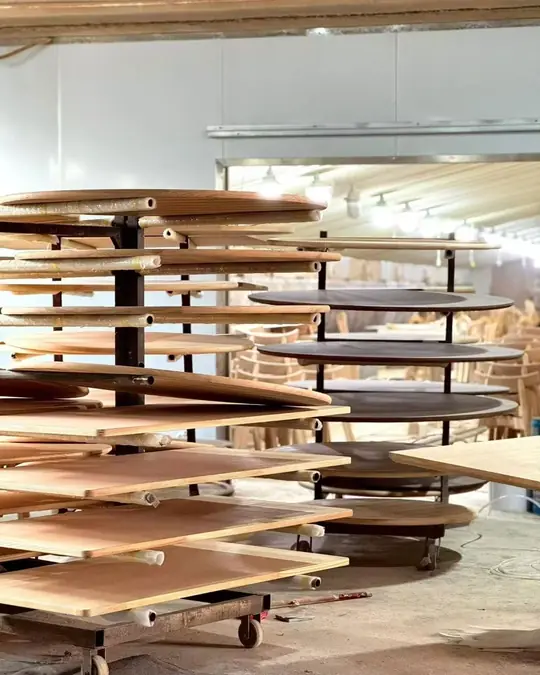
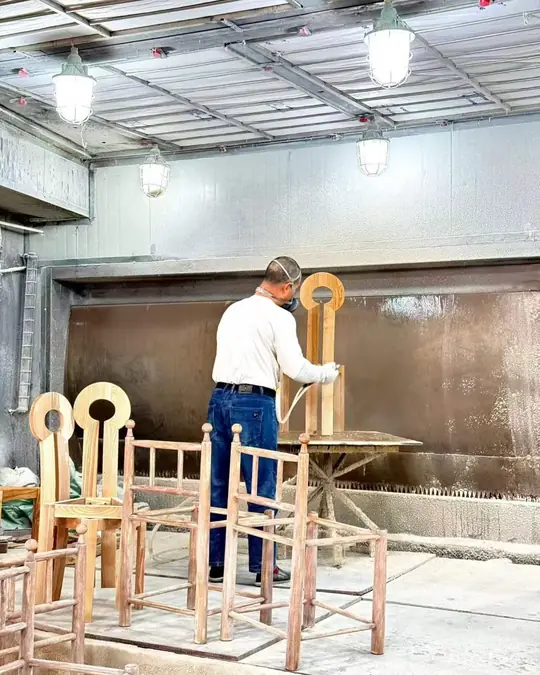
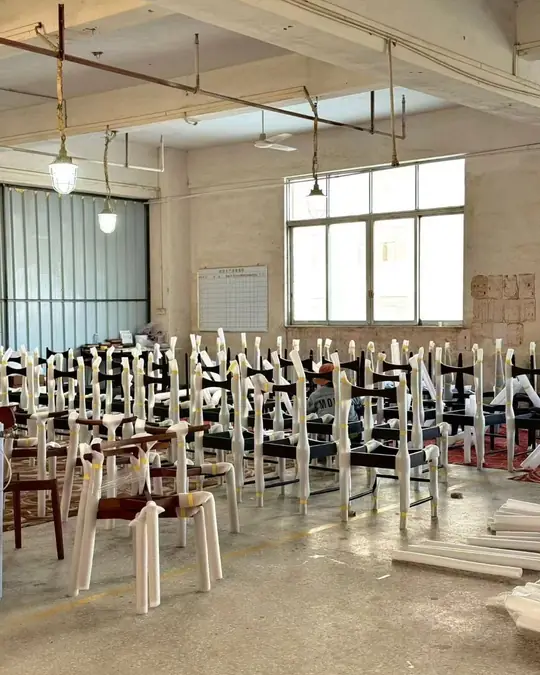
Photographs from timber workshops in Foshan during production — chair frames in assembly, tabletops curing on racks, finishing and packing. The table factory and the chair factory are often different workshops, which is why finish matching needs one reference sample approved by both.


MOQ and price drivers for dining sets
Expect MOQs per SKU rather than per set — chairs often carry higher minimums than tables because upholstery lines run in batches. What moves price: solid vs veneer vs engineered tops, chair joinery complexity, finish steps, and whether the set ships assembled or knocked-down (KD saves freight, adds assembly risk). General MOQ mechanics in MOQ explained; material behaviour in materials for export.
Matching tables to chairs across factories
Because the table factory and the chair factory are often different workshops, finish matching is the #1 failure: same stain code, different timber batch, visibly different set. Lock one finish reference, approve both factories against the same sample, and consolidate into one container at our Foshan warehouse — see consolidation and vetting checklist. Mid-line colour checks catch drift while rework is cheap (QC process).